
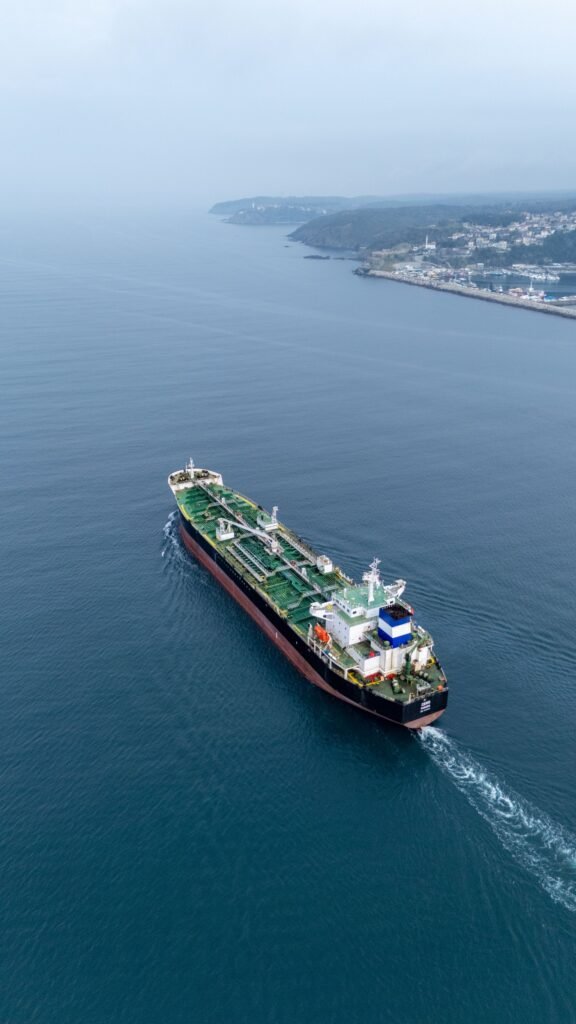
The United States military said on Friday it disabled a commercial ship that tried to run its naval blockade of Iranian ports, in the latest confrontation in a Gulf standoff that has now dragged on for nine months.
US Central Command said a military aircraft fired precision munitions at the stern of the Palau-flagged M/V Pacific Archer on Thursday, after the vessel departed from the Iranian port city of Bandar Abbas and attempted to breach the blockade. The strike disabled the ship’s propulsion system in the Gulf of Oman. The civilian crew was unharmed, the command said.
Ship-tracking websites listed Singapore as the vessel’s destination. The Pacific Archer is at least the 15th vessel publicly disclosed as disabled by American forces since the blockade began in the spring, and the sixth since enforcement resumed in July. The previous vessel was disabled on November 7.
The US has maintained a naval blockade of Iranian ports since April, although it was lifted during talks with Tehran in the summer before being reinstated in July. Since the restrictions began, the US military says it has redirected 158 merchant ships and disabled those that refused to comply. Central Command said on Friday that it “continues to strictly enforce the blockade.”
Tehran answered within hours. The commander of the Iranian navy, Shahram Irani, said on state television on Friday that Iran will carry out operations “that will not only break the naval blockade but also drive the enemy out of the region’s waters.” He added that breaking through the blockade was already under way and that Iran’s ports were active.
Mohammad Mokhber, an adviser to Iran’s Supreme Leader Ayatollah Mojtaba Khamenei, vowed on Friday to break the embargo, according to Iranian state media. “Neither will the Strait of Hormuz be reopened, nor will we allow the blockade to remain in place,” he said.
The Revolutionary Guard separately claimed on Friday that two tankers had attempted to transit the Strait of Hormuz through an “unauthorised” route. It said one vessel struck a naval mine, while the other was forced to turn back. The claims could not be independently verified, and the Guard said the number of oil tankers attempting to transit through unauthorised routes in the critical waterway had sharply decreased in recent days.
The Strait of Hormuz is the narrow waterway between Iran and Oman through which roughly a fifth of the world’s seaborne oil passes. It has been at the centre of the confrontation since the conflict between the United States and Iran began at the end of February. The war has settled into a relative stalemate in recent months, with the Trump administration weighing its options while both sides test each other’s red lines at sea.
For Washington, the blockade is a tool of economic pressure. By intercepting ships leaving Iranian ports, the US aims to choke off the oil revenues that fund Tehran’s government and its military. The approach relies on a large naval presence: the United States has maintained a sizable force in the region, including a constant presence of two aircraft carriers and a host of other ships.
For Tehran, the blockade is an act of war by another name, and the closure of the Strait of Hormuz is its answer. Iran has sought to impose its own blockade on ships transiting the strait, turning the world’s most important oil chokepoint into a contested zone where commercial shipping must navigate two overlapping sets of threats.
Earlier this month, Washington announced Task Force Iron Gate, a new effort to restrict the movement of weapons and sanctioned materials across Iran’s land borders and the Caspian Sea. The move signalled that the blockade at sea is only one part of a wider campaign to isolate Iran economically.
The Pacific Archer incident follows a pattern that has become familiar. A ship leaves an Iranian port, American forces order it to turn back, and when it refuses, aircraft fire on its stern to disable its propulsion without sinking it or harming the crew. The tactic is deliberately calibrated: forceful enough to enforce the blockade, restrained enough to avoid killing sailors or creating an environmental disaster.
But the pattern is also escalating. Iran’s claim that a tanker struck a naval mine in the strait, if true, would mark a dangerous new phase. Mines are indiscriminate weapons, and a minefield in Hormuz would threaten every vessel passing through, including the oil tankers of America’s Gulf allies. The claim could not be verified, and it may be intended as much as a warning as a statement of fact.
The human cost of the standoff is borne by civilian crews. The men and women aboard ships like the Pacific Archer are merchant sailors, not soldiers, caught between a blockade they did not choose and a government whose ports they serve. Each disabling leaves a ship dead in the water in one of the world’s busiest sea lanes, waiting for a tow and a diplomatic resolution.
The wider stakes are economic. Oil prices have been sensitive to every incident in the Gulf this year, and traders watch the strait the way they watch a weather forecast. A full closure of Hormuz would send shockwaves through global energy markets, which is precisely why both sides have so far stopped short of it.
What happens next depends on whether the current tit-for-tat stays at sea or spills over. The Trump administration is weighing its options in a conflict that began in February and has settled into a quiet stalemate. Iran’s navy chief says operations to break the blockade are already under way. The Pacific Archer is the latest ship caught in the middle, and it is unlikely to be the last.
For now, the ship sits disabled in the Gulf of Oman, its crew safe but its voyage over. The blockade holds, the strait stays shut, and the standoff that has defined the Gulf in 2026 grinds on.