
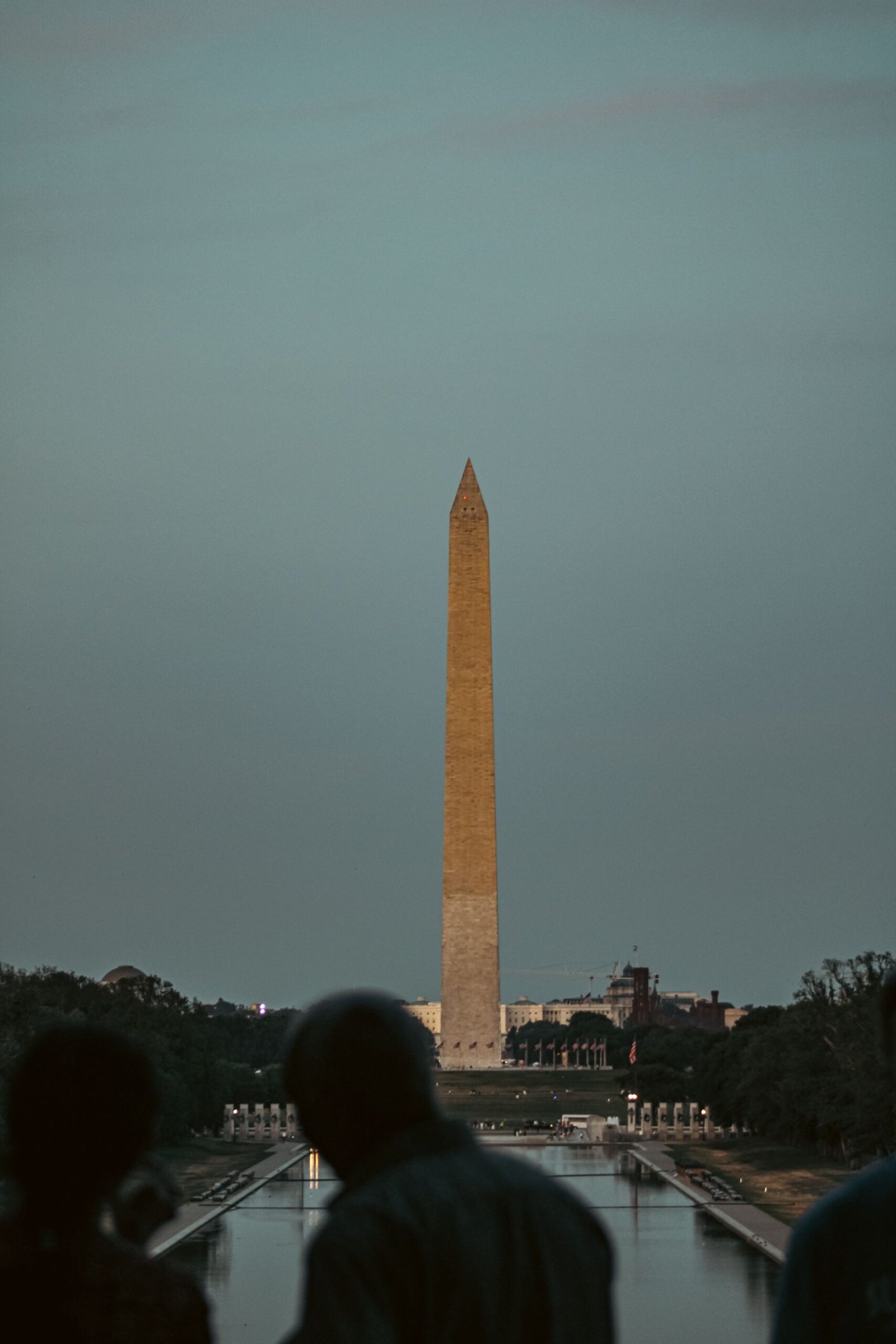
It weighs about 100,000 tonnes. It is made of marble and granite, stands 555 feet tall, and has been rooted to the same spot on the National Mall since 1884. None of that stopped hundreds of people from gathering in Washington, DC, over the weekend to try to push it — a few inches to the left, so that it lines up better with the White House.
The Washington Monument, as anyone who has taken a physics class could have predicted, did not move. Not a millimetre. But the crowd came anyway, pressed their hands against the stone, leaned in together, and gave it their best shot while cameras rolled. The video spread fast, and within hours the internet had done what the internet does best: turned a gloriously pointless group activity into the joke of the week.
The idea, if it can be called that, was simple. The monument sits slightly off the axis that runs between the White House and the US Capitol, and somebody decided that was a problem worth fixing by hand. Hundreds of people showed up to do the fixing. CNN reported on the gathering, and the footage quickly gained traction across social media, where the reactions ranged from affectionate to merciless. “Now I know who failed Physics,” one user wrote. “Maybe try moving the White House instead,” suggested another. A third was blunter still: “This is one of the dumbest ‘movements’ I’ve seen.”
It was not, however, the first time this particular brand of silliness has filled a public square. Just over two weeks earlier, on November 8, hundreds of people gathered at Millennium Park in Chicago to attempt something very similar with the city’s famous Cloud Gate sculpture — better known as the Bean. Their goal was to shift the massive steel sculpture exactly seven inches to the left. They did not succeed either.
The Chicago event started with an anonymous flyer. Somebody printed an invitation, somebody else shared it, and by 12.47 pm on a Sunday afternoon, hundreds of people had turned up at the park, put their hands on the Bean, and pushed. CBS News covered the gathering, which grew out of an online conspiracy theory known as the “Man in the Bean” rumour — the claim that the British-Indian artist Anish Kapoor, who created the sculpture, had trapped a man inside its hollow structure, where he was supposedly living behind the reflective surface, fed and supplied with air through hidden ventilation systems.
The rumour had been simmering for a while. It gained wider attention in July 2025, when a group of protesters dressed in black gathered outside the sculpture on the opening day of the Lollapalooza music festival, demanding that the authorities rescue the person they believed was trapped inside. They claimed that maintenance work around the plaza was secretly being used to supply him with essentials. There is, it should go without saying, no man in the Bean. But the story had enough momentum to get hundreds of people to a park on a Sunday to shove a 110-tonne sculpture.
That is the strange logic of the moment we are living in. A joke becomes a flyer, a flyer becomes a gathering, a gathering becomes a video, and the video becomes the next joke. Nobody involved in pushing the Washington Monument believed they were going to move it. That was never really the point. The point was to be there, to be part of something ridiculous together, and to have a story to tell afterwards. In a year when so much of public life feels heavy and divided, there is something almost wholesome about a crowd of strangers agreeing, just for an afternoon, to attempt something impossible and laugh about it together.
There is also something very American about it. The monument honours George Washington, the first president, and it is the tallest structure in the capital — a 555-foot obelisk that took nearly four decades to complete. Trying to nudge it into better alignment with the White House is, in its own absurd way, a form of civic participation. It is also, inevitably, a form of content. The people who showed up knew the cameras were there. The people watching the video knew it was a stunt. Everybody was in on the joke, and the joke still worked.
The physicists, of course, had their say. Moving 100,000 tonnes of stone would require a force so enormous that no crowd of humans could generate it, and even if they could, the monument’s foundations go deep into the ground. The Bean, for its part, weighs around 110 tonnes and sits on a concrete base; seven inches was never on the table either. But the comments sections were not really about physics. They were about the sheer delight of watching people try. “Now I know who failed Physics” was the most-liked kind of joke, but underneath the teasing there was a grudging admiration for the commitment. It takes a certain kind of confidence to stand in front of a national monument and push.
What comes next is anybody’s guess. The pattern is now established: pick a landmark, pick a direction, print a flyer, show up. The Bean was first, the Washington Monument second, and there will almost certainly be a third. Already, people online are nominating candidates — the Statue of Liberty, Mount Rushmore, the Eiffel Tower — each more immovable than the last. Whether any of them actually happen does not really matter. The format has proven itself: a silly idea, a real crowd, and a video that makes everyone smile.
There is a lesson in all of this, if you want one. Not every gathering needs a cause, and not every public act needs to achieve something. Sometimes a few hundred strangers pushing a monument that will not budge is enough — a reminder that people still like to gather, still like to laugh at themselves, and still enjoy the simple pleasure of trying something ridiculous together. The monument did not move. The White House is still exactly where it was. And somewhere in Washington, a few hundred people went home with sore shoulders, good photos, and a story they will be telling for years.