
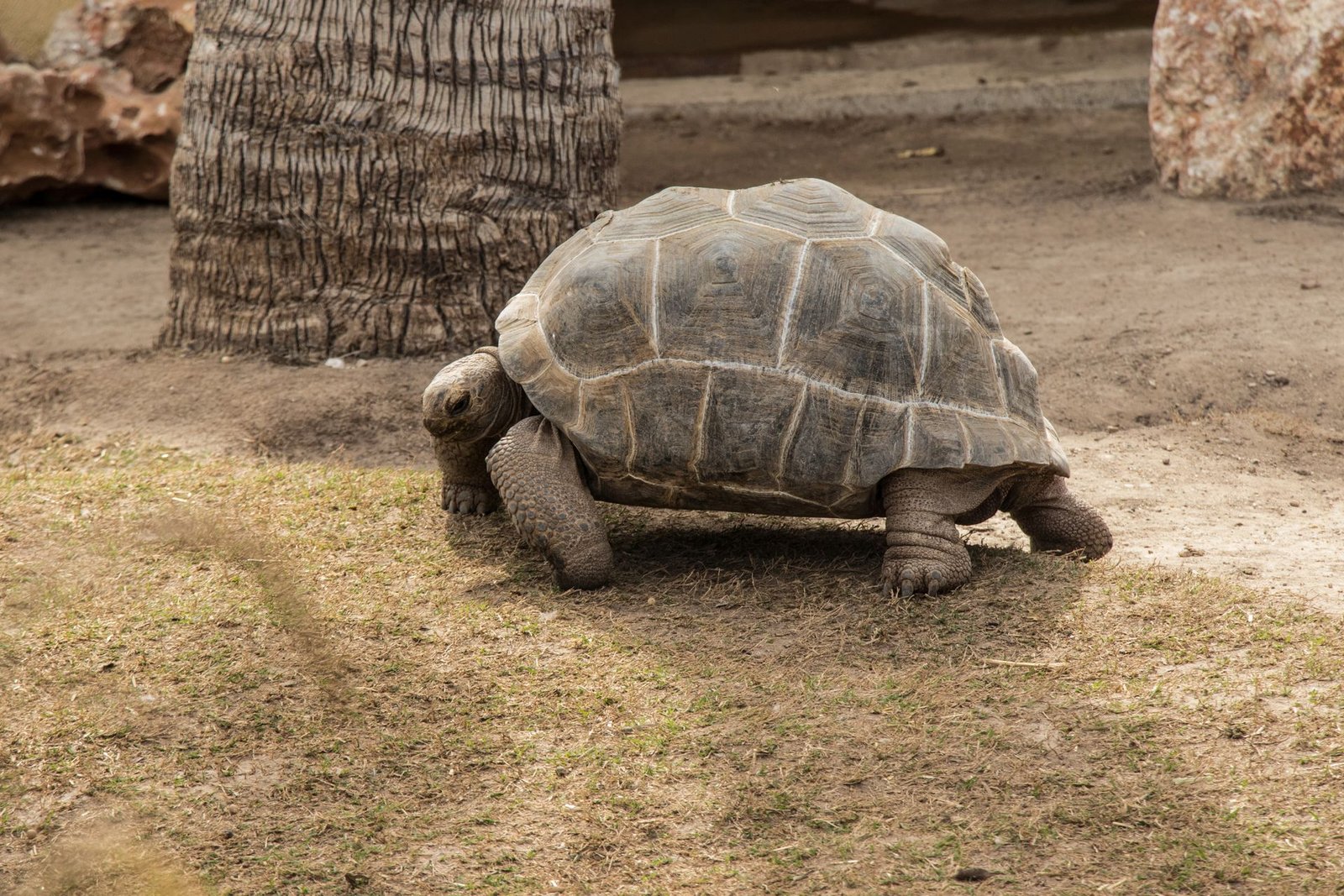
He was already old when the lightbulb was invented. He was middle-aged when the first car rolled off a production line. He has outlived every human being who has ever met him, and this week scientists announced they have finally read his DNA — and found clues that might explain how he did it.
Jonathan is a Seychelles giant tortoise, and at an estimated 194 years old he is the oldest known living land animal on Earth, as well as the oldest verified tortoise in recorded history. He lives on the grounds of Plantation House, the official residence of the governor of St Helena, a remote British territory in the South Atlantic Ocean, where he spends his days grazing on grass and enjoying the sunshine, much as he has for the last century and a half.
The new research, published in the journal Science Advances, looked at Jonathan’s genome in a way nobody had before. A team including researchers from the University of Cambridge and the longevity non-profit Kallel studied samples taken from beneath his tongue — a delicate operation that involved wedging his mouth open with a gloved hand while he tried, understandably, to bite the air. What they found was striking: 287 genetic variants that may be linked to slower ageing, involved in DNA repair, metabolism, inflammation control, insulin regulation and cancer suppression. In the promoters of genes that run his mitochondria and process RNA, Jonathan has kept the tidy, quiet pattern seen in young tortoises, while two older adults in the study had lost it.
Put simply, Jonathan’s body appears to repair itself and keep its cellular machinery in order in ways that most animals, including humans, cannot sustain. He sits roughly a century beyond the usual lifespan ceiling for his kind. The researchers are careful about what that means — they call their findings a hypothesis, and they mean it. The data, they write, are “insufficient to support a direct causal inference.” The study is based on a single tortoise, and a single tortoise cannot prove that these genetic variations are responsible for his extraordinary lifespan. Human treatments, if any ever come from this, are a long way off.
But as a piece of science, it is remarkable, and as a story, it is almost impossible to resist. Jonathan is believed to have hatched around 1832, in the Seychelles in the Indian Ocean. He was brought to St Helena in 1882, already fully grown at around 50 years old, as a gift to Sir William Grey-Wilson, who later became governor of the island. He has lived at Plantation House ever since — through the reigns of six British monarchs, two world wars, the arrival of the telephone, the aeroplane, the internet and the smartphone. In 2022, the island’s governor, Nigel Phillips, granted him an official birthday of December 4. He appears on the back of St Helena’s five-pence coin.
He is, by all accounts, a creature of habit. He grazes. He basks. He naps under trees. His veterinarian, Joe Hollins, knows him well — which is why, earlier this year, a cruel hoax built around Hollins’s name caused such a stir. On April 1, a social media account impersonating Hollins claimed that Jonathan had died overnight, insisted it was not an April Fools’ prank, and then used the outpouring of grief to solicit cryptocurrency donations. The post reached two million views by April 2, and multiple news outlets, including the BBC, reported that Jonathan had died before the hoax was uncovered.
The real Hollins stepped in quickly. “Jonathan the tortoise is very much alive,” he told USA Today, adding that the fake account appeared to be part of a scam. The governor’s office confirmed the tortoise was merely sleeping under a tree. The whole episode became a case study in how fast misinformation travels — and how even a beloved, 194-year-old tortoise can be turned into a vehicle for a scam.
That is part of why this week’s DNA news landed the way it did. The world has spent the year worrying about Jonathan, checking on him, sharing photos of him, and arguing in comment sections about how his age is estimated and whether he is really as old as they say. The answer, according to the science, is yes — and now there is a molecular reason to be amazed by him, not just a sentimental one.
There is something quietly humbling about Jonathan’s life. He has never hurried. He has never chased anything. He eats grass, he sleeps in the sun, and he has done it for nearly two centuries while the world around him reinvented itself a dozen times over. Scientists now think his cells may hold part of the secret to why — 287 small differences in the code of life, keeping the machinery tidy while the rest of us wear out.
Whether those differences will ever help humans live longer is an open question, and the researchers are the first to say so. For now, Jonathan remains what he has always been: a slow, unbothered giant on a small island in the middle of the Atlantic, grazing his way through history. He is 194 years old, he is very much alive, and thanks to a team of scientists with a gloved hand and a scraper, we now know a little more about how he got there.
The way the study was done is almost as charming as its subject. Getting a DNA sample from a tortoise is not like taking a cheek swab. The researchers had to work in the early morning, before bits of plant could spoil the sample, coaxing Jonathan to open his mouth so they could scrape gently beneath his tongue. It is the kind of fieldwork that sounds absurd until you remember what it produced: the first detailed look at the genome of the oldest land animal alive, published in one of the world’s leading science journals.
What the DNA study really gives us is not a recipe for living to 194. It is a reminder that ageing is not a single clock ticking down at the same speed for every creature, and that nature has already solved problems we are only beginning to understand. Jonathan’s 287 genetic variants are not a fountain of youth. They are a map, drawn in the code of a tortoise who has been alive since before photography existed, pointing at the places where the machinery of life can be kept running longer than anyone thought possible.
He will not read the paper, of course. He will be out on the lawn at Plantation House, eating grass, exactly as he was yesterday and the day before that — and, if his genes have anything to say about it, for a good while yet.