
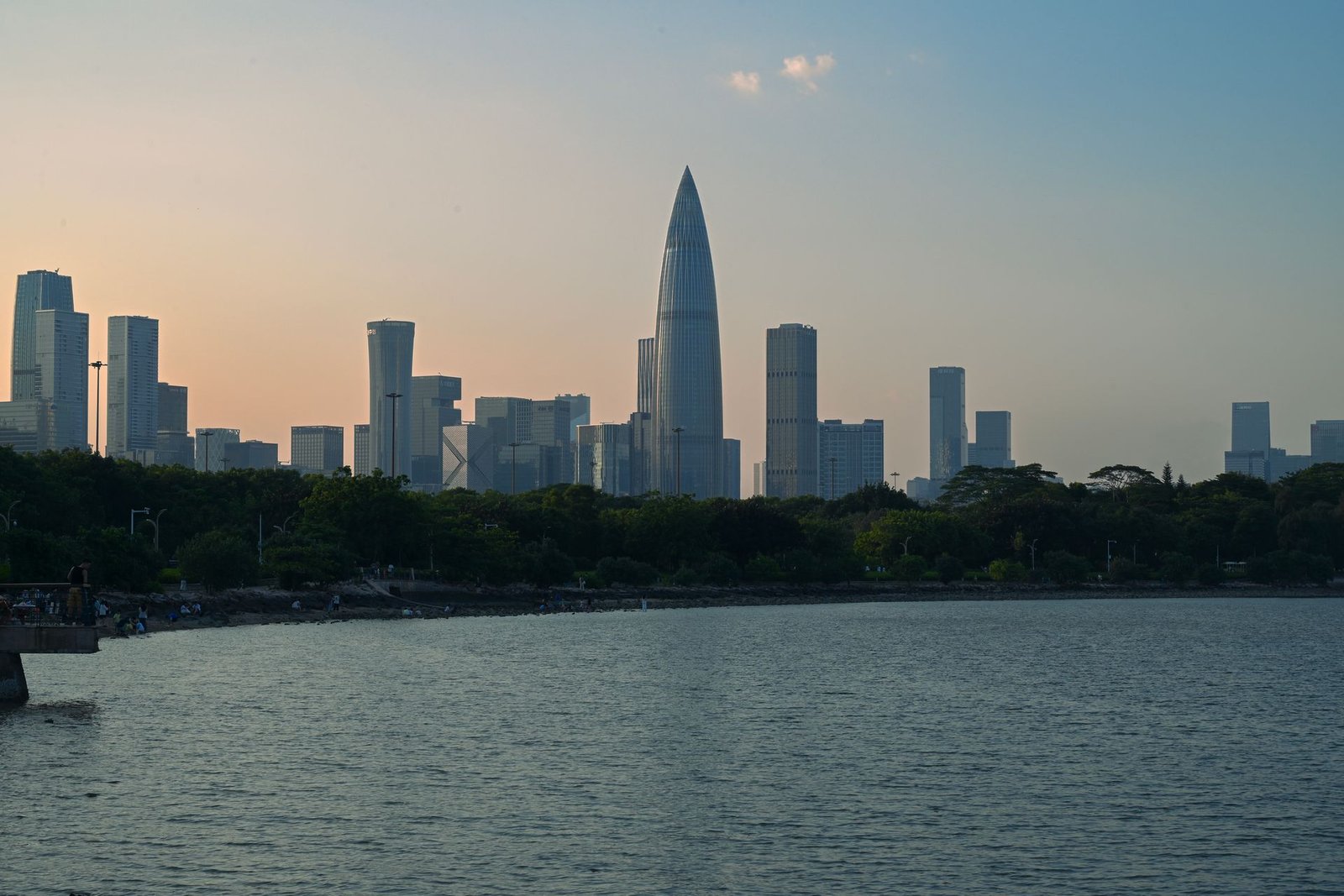
The leaders of the United States, China and Russia have issued a joint declaration on peace after an unprecedented three-way summit in Shenzhen, agreeing to work towards reducing nuclear risks while offering no solution to the wars in Ukraine and Iran.
President Donald Trump, Chinese President Xi Jinping and Russian President Vladimir Putin met on Thursday at Kylin Villa, a villa in the wooded hills beside a lake in the southern Chinese city of Shenzhen, on the sidelines of the Asia-Pacific Economic Cooperation summit. It was the first time the leaders of the world’s three biggest nuclear powers had ever sat down together in this format, and the meeting lasted more than an hour, with the three leaders then issuing a four-point declaration that was published by the White House, the Kremlin and Chinese state media.
The declaration, titled the U.S.-Russia-China Heads of State Declaration toward Peace, commits the three countries to four things. First, they promised to reform the United Nations so that it can respond more effectively to global challenges and live up to its fundamental mission of maintaining international peace and security, though the text does not say which reforms they want. Second, they agreed to increase the production and supply of refined petroleum products for the benefit of all nations, and stressed the importance of stable energy flows.
Third, the three leaders took a swipe at the International Criminal Court, declaring that the principle of state consent and respect for the immunities of state officials are of paramount importance, and that the court and other similar bodies must not abuse their jurisdiction. And fourth, they reaffirmed that a nuclear war cannot be won and must never be fought, and promised to conduct a dialogue on reducing nuclear risks and preventing the proliferation of nuclear weapons, without giving any time frame for that dialogue.
What the declaration did not say was just as important as what it did. It made no mention of Russia’s war in Ukraine, now in its fifth year, and no mention of the conflict between the United States and Iran, which has dominated world headlines in recent weeks. It set no timetable for nuclear arms control talks, and it made no mention of negotiations on a trilateral nuclear arms reduction treaty, something Trump has pushed for and China has rejected, arguing that its nuclear arsenal is much smaller than those of the United States and Russia.
Trump had promoted the meeting as a chance to make history, and he did not hide his excitement. “We are really making history,” he said, adding that the United States, Russia and China are uniquely positioned to discuss how to reduce the number of nuclear weapons on Earth and lessen the risk of those weapons being used. He told the Reuters news agency that the Shenzhen summit was bigger than Yalta, the 1945 conference where the leaders of the United States, Britain and the Soviet Union redrew the map of Europe at the end of the Second World War. Xi told his counterparts that nuclear weapons should be prohibited and destroyed, and called for a nuclear-weapon-free world. Putin, speaking at a press conference afterwards, acknowledged that the declaration did not set ambitious goals, and added that nobody would be forced to comply with its decisions.
The summit was the centrepiece of a three-day diplomatic swing through Asia by Trump, and it came at a difficult moment for the American president at home. His Republican Party lost control of Congress in the midterm elections earlier this month, and analysts said he came to Shenzhen seeking to bolster his standing.
For Putin, the meeting was a diplomatic coup. Russia’s economy is barely a tenth the size of China’s, and most of its businesses are barred from trading with the West by sanctions imposed after the invasion of Ukraine. Yet there he was, sitting as an equal alongside the presidents of the United States and China, in a photograph that will be seen around the world. Analysts said Putin had been one of the clear winners from the summit.
The meeting also worried America’s allies in Europe and Asia, and not only because of the photograph. The summit was held without Ukrainian President Volodymyr Zelenskyy or any European representatives, raising concerns that decisions affecting Ukraine’s future could be discussed without Kyiv at the table. Zelenskyy sidestepped questions about the meeting, and India said it had taken note of the summit and was awaiting more details.
Before the three-way meeting, Trump held separate one-on-one talks with both Xi and Putin. His meeting with Xi was their third substantial meeting this year, and the two leaders discussed trade and other issues between the world’s two largest economies. His sit-down with Putin was the first time the two leaders had held talks since their discussions in Alaska last year, which failed to broker a deal on Russia’s war in Ukraine.
The nuclear question hung over the whole summit. The last nuclear arms pact between Russia and the United States, known as New START, expired in February, leaving the world’s two largest nuclear arsenals without any treaty limits for the first time in decades. Trump has said he wants a new, improved and modernised deal that includes China, but Beijing has shown no interest in joining formal arms control talks while its arsenal remains far smaller than those of Washington and Moscow.
Daryl Kimball, the executive director of the Arms Control Association, said the meeting could at best start a process that would eventually lead to a sustained set of talks on reducing nuclear arsenals. “We need more than diplomatic theater and photo opportunities between Xi, Putin and Trump at APEC,” he said. “And one meeting will not likely produce dramatic breakthroughs.”
That may be the fairest summary of what happened in Shenzhen. The summit was historic in its format, and the declaration it produced was real. But it was also symbolic, short on detail, and silent on the two wars that matter most to the world right now. Trump will hold a news conference in Washington on Friday, and the question he will face is the same one his critics have been asking since he landed in China: was this the start of something, or was it just a photograph?